The Sixteenth-Century Mediterranean Contest: Habsburgs vs. Ottomans
During the first half of the sixteenth century, the central Mediterranean emerged as the primary theater of naval warfare between the expanding Ottoman Empire under Sultan Suleiman the Magnificent and the Habsburg Empire ruled by Emperor Charles V. The declining Hafsid dynasty, which had governed Ifriqiya (modern Tunisia, eastern Algeria, and western Libya) from Tunis since the thirteenth century, was caught between European naval dominance and coastal corsair enclaves.
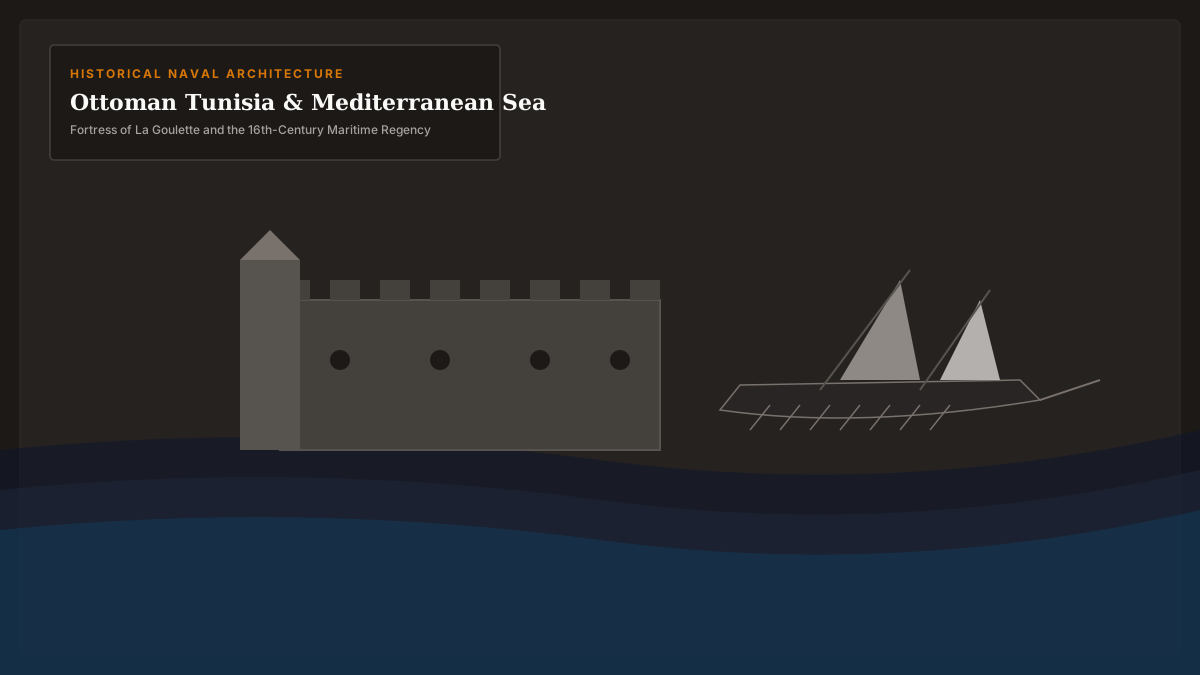
In August 1534, the Ottoman Grand Admiral Hayreddin Barbarossa captured Tunis on behalf of the Sublime Porte, deposing the Hafsid ruler al-Hasan. Recognizing the strategic threat to Sicily and Naples, Charles V organized an armada of over 300 vessels and 30,000 troops, recapturing Tunis in July 1535 and sacking the medina. The Spanish established a permanent garrison at the fortress of La Goulette (Halq al-Wadi), restoring al-Hasan as a tributary vassal.
For the next four decades, control over the Tunisian littoral oscillated. The contest reached its definitive resolution in July–September 1574, when an Ottoman fleet commanded by Kılıç Ali Pasha and a land army led by Sinan Pasha besieged La Goulette and Tunis. The Ottoman forces breached the Spanish bastions, dissolved the Hafsid Sultanate, and formally proclaimed the province of Eyalet-i Tunus, integrating Tunisia into the direct administrative orbit of Istanbul.
Ottoman Administrative Architecture: Pashas, Deys, and the Odjak
Initial Ottoman administration in Tunis was military in character, designed to secure the borderland against Iberian resurgence: - The Pasha: Appointed directly from Istanbul for a three-year term, serving as the official representative of the Ottoman Sultan and nominal governor-general. - The Diwan and the Odjak: A military council composed of the senior officers of the odjak (the Ottoman Janissary garrison stationed in Tunis, recruited predominantly from Anatolia and the Balkans). - The Deys: By 1591, junior Janissary officers revolted against the higher-ranking commanders and the Pasha, electing an executive leader from their own ranks known as the Dey. During the reign of Othman Dey (1598–1610) and Yusuf Dey (1610–1637), the Dey functioned as the de facto head of government, presiding over civil administration and trade alliances.
Simultaneously, responsibility for collecting taxes from the interior rural tribes and maintaining order outside the capital fell to the Bey, commander of the seasonal military expedition (al-mahalla). This division between maritime-urban power (the Dey) and territorial inland command (the Bey) set the stage for dynastic centralization.
From Military Rule to Hereditary State: The Muradid and Husainid Dynasties
Over the course of the seventeenth and eighteenth centuries, local governors gradually achieved administrative autonomy from Istanbul while retaining formal Ottoman suzerainty and religious allegiance:
- The Muradid Dynasty (1613–1702): Founded by Murad Corso, a Corsican convert recruited into the Ottoman administration, the Muradids transformed the office of Bey into a hereditary monarchy. Murad Bey and his successors (notably Hammuda Pasha Bey) subdued rival Janissary factions, patronized religious endowments (habous), built mosques throughout Tunis, and centralized fiscal control over customs and interior commerce.
- The Husainid Dynasty (1705–1957): Following a period of civil instability and Algerian intervention, Husayn ibn Ali, an Ottoman cavalry officer of Cretan ancestry, assumed power in July 1705, establishing the Husainid dynasty. Under the Husainids, Tunisia experienced institutional maturation, establishing diplomatic treaties with European states and developing a distinctive Tuniso-Ottoman architectural and scholarly culture. The dynasty endured until the abolition of the monarchy and the declaration of the Tunisian Republic in 1957.
Corsairing in Historical Context: Fiscal-Military Statecraft and the "Jihad al-Bahr"
Nineteenth-century European colonial narratives frequently described North African maritime activity under the blanket, pejorative term "Barbary piracy." Modern historical scholarship—led by scholars such as Fernand Braudel, Michel Fontenay, and Kenneth Perkins—contextualizes this maritime activity as state-sanctioned privateering (corso or jihad al-bahr), forming one half of a reciprocal Mediterranean maritime conflict that characterized European and Islamic relations for over three centuries.
Key aspects of this maritime framework include: - Legal and Sovereign Authority: Unlike stateless piracy, corsair voyages sailed under official letters of marque granted by the Dey or Bey. Captains were required to adhere to formal rules of engagement, avoid ships flying flags of nations with whom Tunis had ratified peaceful capitulation treaties, and bring all seized prizes before the maritime court (Diwan al-Bahr) in Tunis. - The Taifa of Rais: Corsair commanders were organized into a professional guild headed by the Captain Rais. Many leading captains were Muslim refugees expelled from Andalusia (Moriscos) following the 1609 edicts of Philip III, bringing advanced European seafaring and navigational expertise to harbors such as Ghar al-Milh (Porto Farina), Bizerte, and La Goulette. - Reciprocal Maritime Warfare: European powers maintained an identical privateering apparatus. The Knights of Saint John of Malta and the Order of Saint Stephen of Tuscany operated state-sanctioned corsair fleets systematically capturing Ottoman and North African commercial vessels, enslaving Muslim crews and passengers, and auctioning seized cargoes in Valletta and Livorno.
Ransoming Institutions, the Bagne, and Commercial Treaties
The economics of the Mediterranean corsair conflict centered on prize vessels, valuable cargoes (cloth, silver coin, grain, timber), and ransom captives (captifs). Captives were housed in designated quarters known as bagnes in Tunis. Catholic religious orders, specifically the Trinitarians and the Mercedarians (Pères de la Rédemption), raised charitable funds across Europe to negotiate ransoms with the Beylic court.
By the early eighteenth century, income from privateering declined steadily relative to lawful maritime commerce. The Husainid Beys negotiated lucrative bilateral trade conventions with France, Great Britain, Venice, and the Netherlands, exporting Tunisian olive oil, wool, grain, and Chechia caps (shashiya) across the Mediterranean basin. Privateering was formally suppressed across the Mediterranean following the Napoleonic Wars, culminating in international agreements at the Congress of Aix-la-Chapelle (1818) and Anglo-French naval interventions in 1819.
Historiographical Analysis and Terminology Guide
Understanding Ottoman Tunisia requires distinguishing between polemical primary sources and objective historical terminology:
- Corsair vs. Pirate: A corsair (ra'is) operated under the legal mandate of a sovereign state during wartime; a pirate was an unlawful, stateless brigand condemned under Islamic jurisprudence (hiraba) as well as European admiralty law.
- Eyalet vs. Beylik: While Istanbul designated the territory Eyalet-i Tunus (an imperial province), European diplomats referred to it as the "Regency of Tunis," and internal Arabic chronicles recognized the sovereign autonomy of the Beylik.
- The Morisco Impact: The settlement of thousands of Andalusian Muslims in Testour, Soliman, and Zaghouan during the early seventeenth century injected horticultural innovations, Andalusian architecture, and Andalusian musical traditions (maluf) that deeply enriched Tunisian culture.