Qatar’s Pre-Oil Economy: Pearling Hegemony and Economic Crisis
For centuries, the arid peninsula of Qatar was celebrated throughout the Indian Ocean for the quality and luster of its natural pearls. During the height of the pearling boom in the late nineteenth and early twentieth centuries, maritime pearl diving (al-ghaws al-kabir) was the foundation of national survival. Over 800 dhows sailed from coastal ports such as Al-Zubarah, Al-Khor, Al-Wakra, and Al-Bida (modern Doha) every summer, employing nearly half the male population as divers (ghawas) and pullers (seyb).
This economic pillar collapsed abruptly between 1928 and 1933 due to the compounding impact of two international developments: 1. The Japanese Cultured Pearl: Entrepreneur Kokichi Mikimoto perfected commercial spherical pearl cultivation techniques, flooding global jewelry markets with inexpensive cultured pearls. 2. The Great Depression: The 1929 international economic contraction severely curtailed demand for luxury goods in Europe and North America.
By the early 1930s, natural pearl prices plummeted by over 80%. Many Qatari families faced acute hardship, prompting widespread emigration to regional commercial centers such as Basra and Kuwait.
Geological Reconnaissance and the 1935 Concession Agreement
Encouraged by successful oil strikes in neighboring Bahrain (1932) and Saudi Arabia (1938), international oil conglomerates turned attention to the Qatari mainland. In May 1935, following prolonged negotiations between Sheikh Abdullah bin Jassim Al Thani (Ruler of Qatar, 1913–1949) and Charles C. Mylles representing the Anglo-Persian Oil Company (APOC), a 75-year exclusive concession agreement was executed.
Under the terms of the convention, APOC established an operating subsidiary, Petroleum Development (Qatar) Ltd. [PDQ], an affiliate of the Iraq Petroleum Company consortium. The agreement provided an immediate signature bonus of 400,000 rupees and an annual rental payment of 150,000 rupees pending commercial discovery, offering vital financial relief to the Qatari treasury during the depth of the regional depression.
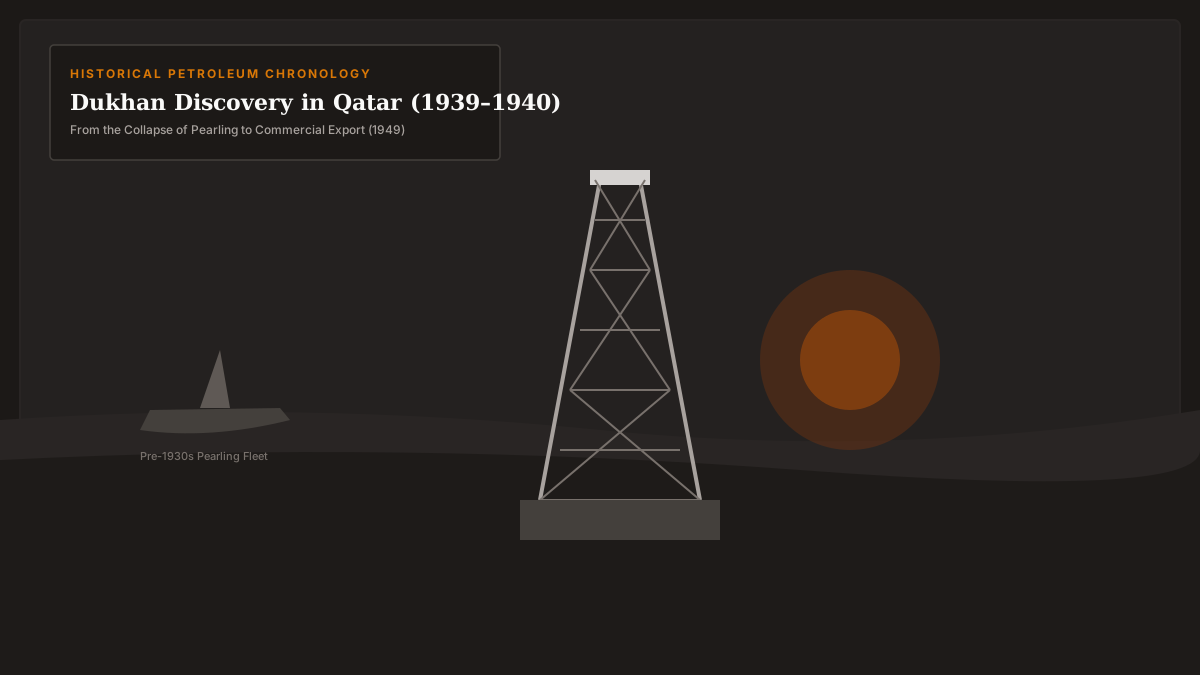
The Historic Strike at Dukhan Well No. 1 (1939–1940)
Geological surveys identified a promising low-relief north-south surface anticline along the western coast of the peninsula at Jabal Dukhan ("Hill of Smoke"). In October 1939, heavy rotary drilling equipment was landed on the beach and transported across the desert to spud Dukhan Well No. 1.
Drilling proceeded through hard limestone, anhydrite, and dolomite. In January 1940, at a total depth of 5,685 feet (1,733 meters), the bit penetrated the Upper Jurassic limestone sequence known as the Arab Zone. The well struck oil under strong natural reservoir pressure, flowing at an initial tested rate of approximately 4,480 barrels of light crude per day. Two confirmation appraisal wells (Dukhan No. 2 and No. 3) were drilled shortly thereafter, confirming a continuous onshore oilfield stretching over 70 kilometers along the western flank of Qatar.
World War II Interruption and Post-War Reconstruction
The outbreak and intensification of World War II severely disrupted operations. Shortages of steel casing, drilling bits, and maritime tanker transport halted field development. In 1942, under British wartime emergency directives, all three completed Dukhan wells were plugged with mechanical bridge plugs and capped with cement to prevent capture or exploitation by Axis forces in the event of an advance into the Persian Gulf.
Exploration personnel were evacuated, leaving only a minimal custodial watchman presence at the desert camps. Active field development did not resume until late 1947, when mechanical crews re-drilled the cement plugs, constructed modern road links across the rocky hamada desert, and built a dedicated oil-pipeline corridor.
The First Commercial Export (1949) and the Mesaieed Terminal
Because the shallow, reef-strewn waters off the western coast near Dukhan could not accommodate deep-draft ocean-going oil tankers, petroleum engineers surveyed an overland pipeline corridor across the breadth of the peninsula. A 73-mile, 12-inch and 14-inch crude pipeline was constructed from the Dukhan separation plant to the sheltered deepwater port of Umm Said (today known as Mesaieed) on the southeastern coast.
On December 31, 1949, the British tanker President Meny lifted the historic first commercial shipment of Qatari crude from Mesaieed, loading approximately 80,000 barrels bound for European refineries. This milestone concluded Qatar’s era of subsistence hardship and marked its debut as a major international energy exporter.
Infrastructure Building and Societal Evolution
Petroleum royalties transformed Qatari society within a single generation under Sheikh Abdullah bin Jassim, his son Sheikh Ali bin Abdullah Al Thani, and their successors: - Urban Modernization: In 1952, the state commissioned Qatar’s first diesel-powered municipal electricity generating station in Doha, followed shortly by seawater thermal desalination evaporators that eliminated reliance on saline desert wells. - Healthcare & Education: Qatar opened its first modern public hospital (Rumailah Hospital) in 1957, alongside a nationwide network of free public primary and secondary schools. - Offshore Discoveries & The North Field: Subsequent decades witnessed the discovery of offshore fields (Idd El-Shargi in 1960 and Maydan Mahzam in 1963), culminating in the 1971 discovery of the gigantic North Field (al-Haql al-Shamal). Containing roughly 10% of the world's known natural gas reserves, the North Field positioned Qatar at the forefront of the global liquefied natural gas (LNG) industry.