Pre-Modern Seepages and Mesopotamia’s Bitumen Heritage
Petroleum hydrocarbons have played a structural role in the Tigris-Euphrates river basin for several millennia before modern deep rotary drilling. Naturally occurring surface seepages of bitumen, maltha, and heavy crude were exploited extensively across ancient Mesopotamia. At the ancient city of Hit on the Euphrates—referenced in Akkadian tablets as well as classical Greek texts—seeping bitumen pits furnished waterproofing mortar for monumental brick architecture in Ur, Babylon, and Nineveh.
Bitumen bonded palace foundations, sealed riverine reed coracles (the ancestral quffa still observed in early 20th-century marsh navigation), and caulked irrigation canals against water erosion. Herodotus recorded in the fifth century BCE that the mortar used in the defensive fortifications of Babylon was drawn from the springs of Is (Hit). These surface manifestations signaled rich subsurface hydrocarbon traps, which became the prime focus of international geological expeditions during the late Ottoman era.
The Ottoman Concession Era and the Turkish Petroleum Company
During the final decades of the nineteenth century, Ottoman Sultan Abdul Hamid II issued imperial decrees (firmans) transferring rights over petroleum seepages in the vilayets of Baghdad and Mosul directly to the Privy Purse (Hazine-i Hassa). As European powers recognized the strategic naval shift from coal to liquid fuel, rivalry intensified among British, German, and French financiers seeking exploration concessions along the planned Berlin-Baghdad Railway corridor.
In 1912, the British financier Sir Ernest Cassel, the Deutsche Bank, and the National Bank of Turkey established the African and Eastern Concessions Ltd., soon renamed the Turkish Petroleum Company (TPC). Calouste Gulbenkian, an Armenian entrepreneur instrumental in brokering the consortium, secured a permanent five percent non-voting interest—earning him the moniker "Mr. Five Percent." Following the dissolution of the Ottoman Empire after World War I and the subsequent League of Nations British Mandate over Mesopotamia, the 1920 San Remo Agreement allocated Germany’s confiscated shares to the French state-backed Compagnie Française des Pétroles (precursor of TotalEnergies).
In March 1925, the newly established Kingdom of Iraq signed a comprehensive 75-year convention with TPC covering an area of 192,000 square miles across the Baghdad and Mosul provinces.
The 1927 Baba Gurgur Gusher and the Red Line Agreement
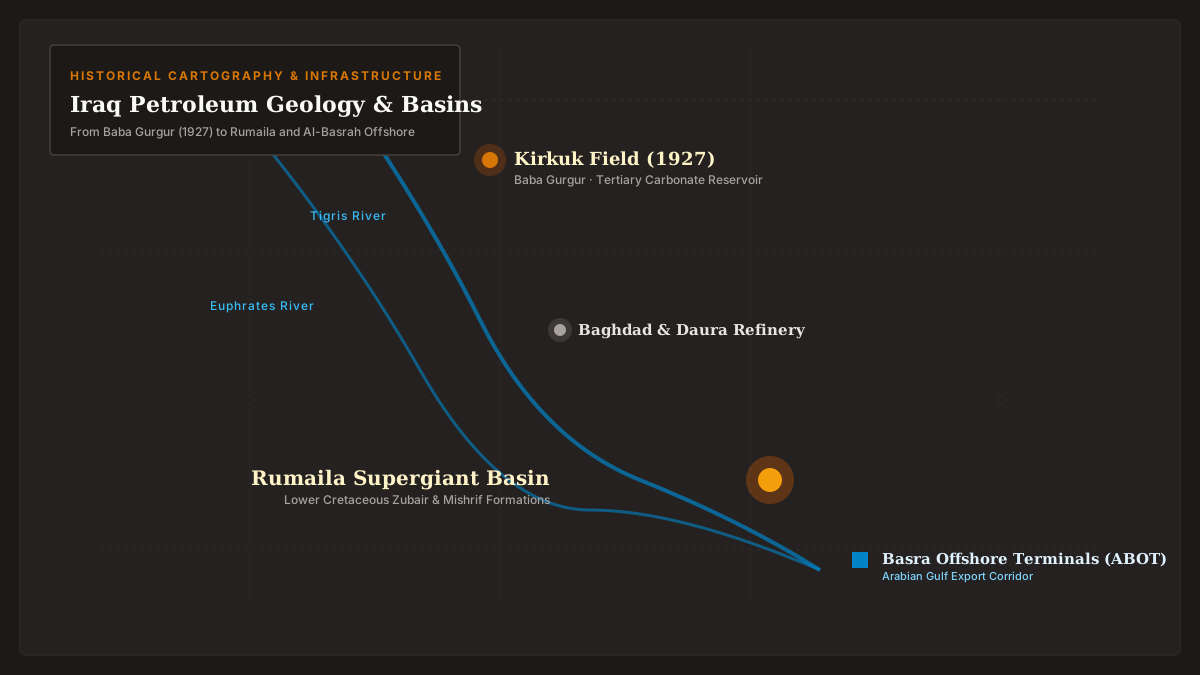
The commercial viability of Iraq’s petroleum resources was established definitively on October 14, 1927, at Baba Gurgur Well No. 1, located just north of Kirkuk. Drilling through limestone overburden, the drill string penetrated the prolific Oligocene-Eocene reservoir, triggering a massive blowout that erupted oil more than 140 feet into the air. The well flowed an estimated 95,000 barrels per day before drilling crews, working with local laborers, managed to cap the blowout after eight days of continuous containment operations.
The magnitude of Baba Gurgur catalyzed a formal reorganization of the operating consortium. In 1928, the participants signed the landmark Red Line Agreement, legally binding the partners (Anglo-Persian Oil Company, Royal Dutch Shell, Compagnie Française des Pétroles, and the Near East Development Corporation representing American majors Exxon and Mobil) not to seek independent petroleum concessions within the boundaries of the former Ottoman Empire without consortium participation. In 1929, the TPC was officially renamed the Iraq Petroleum Company (IPC).
Post-WWII Field Discoveries: Basra and the Southern Supergiants
While northern operations centered on Kirkuk, exploration expanded toward the southern wetlands and desert borders following the 1938 creation of the Basrah Petroleum Company (BPC), an IPC affiliate. Operations were delayed by logistical constraints during World War II, but geological mapping resumed aggressively after 1945.
In 1948, drilling crews confirmed commercial oil in the Zubair field southwest of Basra. Even more significant was the 1953 discovery of the Rumaila supergiant field, one of the largest continuous petroleum reservoirs on earth. Producing primarily from high-permeability Lower Cretaceous Zubair sandstones and Upper Cretaceous carbonates, Rumaila and its subsequent extensions (Rumaila North and South) transformed the center of gravity of Iraqi production from the northern foothill belt to the Arabian Gulf basin.
Public Law 80 and the Nationalization Movement (1961–1972)
Tensions between the concessionaires and the Iraqi state escalated over concession terms, royalty calculation formulas, and the pacing of field development. On December 11, 1961, the government of Abd al-Karim Qasim enacted Public Law 80, which restricted IPC and its sister companies to the 0.5% of the total concession territory where commercial production was already taking place. All unexploited concession acreage—including the unproduced northern sectors of Rumaila—reverted to the direct control of the state.
In 1964, the government established the Iraq National Oil Company (INOC) to explore and operate reclaimed acreage independently or through bilateral service agreements, notably partnering with the Soviet Union to develop North Rumaila. In June 1972, following protracted negotiations over pricing and export quotas, the Iraqi government nationalized the assets of the Iraq Petroleum Company. Subsequent agreements brought the Mosul Petroleum Company and the Basrah Petroleum Company under full state ownership by 1975, concentrating upstream management under state-owned operating entities.
Major Producing Basins and Geological Characteristics
Iraq’s hydrocarbon endowment is situated along the northeastern Arabian Platform, where deep sedimentary sequences and gentle structural folding created ideal reservoir-seal combinations. Two primary hydrocarbon provinces dominate national output:
- The Southern Basin (Basra-Missan-Dhi Qar): Characterized by high-capacity sandstone and limestone formations of Cretaceous age (primarily Zubair and Mishrif formations). These reservoirs exhibit exceptional porosity, high permeability, and low production costs per barrel. Major fields include Rumaila, West Qurna (Phases 1 and 2), Zubair, Majnoon, and Halfaya. The crude is predominantly light to medium sour.
- The Northern and Zagros Foothill Basin (Kirkuk-Nineveh): Characterized by fractured Tertiary carbonates, most notably the Main Limestone reservoir of the Kirkuk structure. Traps were formed by Zagros compressional folding. Prominent fields include Kirkuk (Baba, Avanah, and Khurmala domes), Bai Hassan, Jambur, and Ain Zalah.
- Central Basins: Featuring large accumulations of heavy and medium crude, notably the sprawling East Baghdad field and the Ahdab field in Wasit Governorate.
Export Infrastructure, Pipeline Corridors, and Terminals
Because Iraq possesses a relatively narrow maritime coastline (approximately 58 kilometers along the Arabian Gulf), evacuating crude to international markets has historically required a combination of deepwater offshore terminals and cross-border pipeline corridors:
- Southern Maritime Terminals: The vast majority of Iraqi crude is exported via offshore terminals in the northern Gulf: the Al-Basrah Oil Terminal (ABOT) and the Khor Al-Amaya Oil Terminal (KAAOT), complemented by Single Point Mooring (SPM) buoys anchored off the Al-Faw peninsula. Crude is fed from storage depots at Zubair and Al-Faw via pressurized trunklines.
- The Kirkuk-Ceyhan Pipeline: Designed to transport northern crude across Turkish territory to the Mediterranean port of Ceyhan. The corridor consists of dual pipelines (40-inch and 46-inch diameters) traversing Anatolia, subject to periodic geopolitical negotiations and technical maintenance agreements.
- Domestic Refining: Primary refining centers include the Baiji North Refinery complex in Salahuddin, the Basra Refinery at Shuaiba, and the Daura Refinery in southern Baghdad, providing refined gasoline, diesel, and kerosene for domestic power generation and consumer transit.
Institutional Governance and OPEC Participation
Iraqi petroleum policy is formulated and supervised by the federal Ministry of Oil in Baghdad. Regional state-owned operating companies execute field activities: - Basra Oil Company (BOC): Oversees the southern fields, contributing over 70% of total national volume. - North Oil Company (NOC): Manages historical assets in Kirkuk, Nineveh, and adjacent northern governorates. - Midland Oil Company (MdOC) and Missan Oil Company (MOC): Coordinate central fields and eastern border developments. - State Organization for Marketing of Oil (SOMO): Holds the exclusive statutory monopoly for contracting international crude sales, coordinating pricing differentials (Official Selling Prices), and auditing tanker liftings.
Iraq was one of the five founding members of OPEC at the historic Baghdad Conference in September 1960, alongside Saudi Arabia, Iran, Kuwait, and Venezuela. Within the OPEC+ framework, Iraq coordinates baseline quotas while managing domestic budgetary requirements heavily reliant on oil receipts.