Bahrain Before Petroleum: Pearling Capital and Dilmun Heritage
For over four thousand years, the archipelago of Bahrain served as the maritime nexus of the Persian Gulf. Known in ancient Sumerian cuneiform records as Dilmun, Bahrain flourished through fresh artesian spring aquifers bubbling up amidst the sea, supporting date palm cultivation and international trading fleets between Mesopotamia and the Indus Valley.
By the nineteenth and early twentieth centuries, Bahrain was recognized as the undisputed capital of the international natural pearl market. The island of Muharraq and the capital port of Manama housed merchant dynasties (tajir al-lu'lu') financing seasonal pearling expeditions across the surrounding oyster beds (hayrat). However, just as in neighboring Qatar, the invention of Japanese cultured pearls and the 1929 Great Depression devastated pearling earnings, leaving thousands of divers in debt and underscoring the urgent imperative for alternative economic livelihoods.
Major Frank Holmes and the Concession Battle
The discovery of oil in Bahrain was largely propelled by a tenacious New Zealand-born mining engineer, Major Frank Holmes. Having observed surface seepages and oil signs during military service in the Middle East during World War I, Holmes became convinced that vast petroleum deposits underlay the limestone formations of the Arabian Gulf.
In 1920, Holmes co-founded the Eastern and General Syndicate in London. Established British geologists—most notably those advising the Anglo-Persian Oil Company—scoffed at his theories, claiming that the geology of the Arabian peninsula was composed solely of barren water-bearing limestone. Undeterred, Holmes arrived in Bahrain in 1922, winning the trust of Sheikh Hamad ibn Isa Al Khalifa (deputy ruler and later Ruler of Bahrain, 1932–1942) by using geological water-drilling rigs to drill artesian freshwater wells in parched villages.
In December 1925, Sheikh Hamad granted Holmes’s syndicate a pioneering two-year exploration concession. When British conglomerates repeatedly refused to finance exploratory drilling in Bahrain, Holmes traveled to the United States.
The American Entry: Socal and the Creation of BAPCO
In 1928, the Standard Oil Company of California (Socal) acquired the Bahrain concession options from Holmes’s syndicate. Because Bahrain was bound to Great Britain under protective treaty relationships that required British commercial nationality clauses, Socal incorporated an operating subsidiary in Canada (a British dominion) in January 1929: the Bahrain Petroleum Company Limited (BAPCO).
British imperial officials initially resisted American operational control, but after protracted diplomatic exchanges between Washington and the British Foreign Office, formal drilling rights were ratified in August 1930. Socal geologists Fred A. Davies and William F. Hoover arrived to survey the central depression of the main island.
The Historic Strike at Jebel Dukhan Well No. 1 (June 1932)
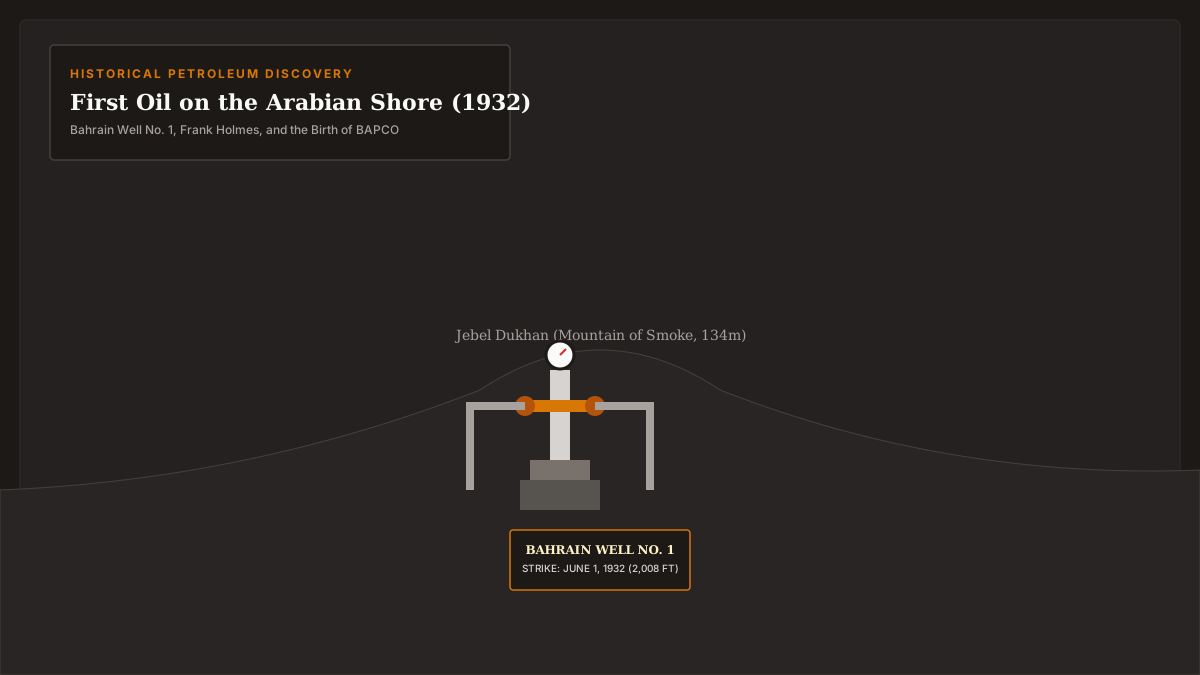
Drilling equipment and steel casing were offloaded on the beaches of Sitra and hauled inland across treacherous sabkha salt flats. On October 16, 1931, crews spudded Bahrain Well No. 1 near the base of Jebel Dukhan (the "Mountain of Smoke," Bahrain’s highest limestone hill at 134 meters).
Drilling proceeded through the winter. At 3:45 AM on June 1, 1932, at a depth of 2,008 feet (612 meters), the drill bit encountered porous Cretaceous limestone saturated with oil. Pressurized sweet crude surged up the drill pipe, accompanied by natural gas. The well was tested at an initial flow rate of approximately 1,400 barrels per day.
The strike at Bahrain Well No. 1 was a watershed moment in world history: it was the very first commercial oil discovery on the Arabian side of the Persian Gulf. It proved conclusively that the Arabian shelf contained major hydrocarbon reserves, leading Socal immediately to negotiate the historic 1933 concession in nearby Saudi Arabia, which culminated in the discovery of Dammam Well No. 7 in 1938.
Infrastructure Development: The Sitra Refinery and Awali
To process and commercialize the discovery, BAPCO constructed modern energy infrastructure across the main island: - Awali Township: Constructed in the 1930s as a master-planned desert community south of Jebel Dukhan, Awali was Bahrain’s first fully air-conditioned modern township, providing housing, schools, and medical facilities for engineers and local workers. - Sitra Refinery (1936): Recognizing that Bahrain’s domestic crude reserves were modest compared to potential regional finds, BAPCO erected a major refining complex at Sitra. The refinery expanded rapidly during World War II, playing a pivotal role in supplying aviation fuel and diesel to Allied naval and air operations across the Mediterranean and Asian theaters. - The Trans-Arabian Pipeline Link: In 1945, BAPCO laid a 34-mile subsea and overland pipeline from Saudi Arabia’s Dammam field directly to the Sitra refinery, ensuring a continuous supply of crude for refining and re-export.
Socio-Economic Modernization and the Post-Oil Model
Bahrain’s earlier encounter with oil prompted pioneering societal investments long before neighboring Gulf states: - Education and Technical Training: BAPCO established rigorous vocational apprenticeship programs in the 1940s, training thousands of Bahraini nationals as certified mechanics, petroleum engineers, and administrative supervisors. - Healthcare & Municipal Services: Oil receipts funded the eradication of malaria from coastal towns, public water distribution systems, and the opening of the Salmaniya Medical Complex. - Early Economic Diversification: Because Bahrain’s total oil reserves were finite compared to its neighbors, the kingdom became the first Gulf nation to pursue aggressive structural diversification in the 1970s—developing aluminum smelting (Alba), dry-dock ship repair (ASRY), and offshore international Islamic banking in Manama.